Tobacco substitutes: a good way to stop smoking?
A tobacco substitute can help you give up cigarettes, provided you choose the right one and use it properly. Nicotine replacement products such as patches, gum and lozenges increase the chances of success by 50 to 70%, according to France’s national health insurance, the Assurance Maladie [1]. Herbal blends, on the other hand, mainly replace the gesture, without acting on nicotine dependence.
This guide compares these options, how well they really work, the reviews worth knowing, their effects and their cost, then presents a gentle, substance-free alternative.
KEY TAKEAWAYS
- The term tobacco substitute covers two opposite families: nicotine replacement products (patches, gum, lozenges) and nicotine-free herbal blends.
- When used properly, nicotine replacement products increase the chances of quitting by 50 to 70%, but they maintain a dependence on the molecule [1].
- Herbs, CBD and hemp still involve combustion and smoke: their appeal is above all sensory.
- Correct use and the right dosage make all the difference to how well they work.
- Laser auricular reflexology offers an alternative with no substance, in a session of about one hour, designed to act directly on cravings.
What is a tobacco substitute?
Definition of a tobacco substitute
The term refers to any product designed to replace cigarettes, either to cut down or to support quitting completely. Behind this word lie two quite different approaches.
Nicotine replacement products deliver nicotine without combustion or the toxic substances in smoke. Herbal blends, by contrast, reproduce the ritual and the flavours, without nicotine but with very real combustion. Confusing the two leads to disappointment.
The different types of tobacco substitutes
There are two main categories, with very different effects on smoking:
| Type | Nicotine? | Combustion | Main role |
|---|---|---|---|
| Patches, gum, lozenges, sprays | Yes | No | Offset physical withdrawal |
| Herb and flower blends | No | Yes | Reproduce the gesture and the flavours |
| CBD / hemp products | Sometimes THC | Yes | Relaxation, sensory transition |
Nicotine replacement products
The patch releases nicotine continuously through the skin, while oral forms (gum, tablets, lozenges, sprays, inhalers) act faster when a craving strikes. The principle: release the molecule gradually to ease withdrawal, without the tar produced by combustion [2]. These products do not remove the dependence; they make it manageable during the withdrawal period.
Herb- and flower-based tobacco substitutes
This family includes plants for smoking: raspberry leaf, hazel leaf, chamomile, lemon balm, sage and sometimes hemp leaf. Many of these traditional products add CBD or hemp, as flowers intended for vaporising. Marketed as natural, they rely on relaxing properties, soothing aromas and a sensory experience. These touted properties are mostly a matter of perception: there is no evidence that they help people stop smoking.
Without nicotine, they do not act on physical dependence. And combustion remains the main source of harmful chemical compounds: a ‘natural’ leaf is not risk-free once it is burnt. Hemp-derived CBD may also contain THC, even at low levels: check the origin and THC content of hemp flowers. Vaporising CBD avoids combustion, but does not remove the dependence on the gesture. CBD remains a relaxation product: it is a transition, not a validated aid to quitting smoking.
Are tobacco substitutes effective for quitting smoking?
Their effectiveness depends on the type of product and how it is used. Opinions often differ because people compare solutions that do not play the same role.
Maintaining a form of dependence
Nicotine replacement products keep supplying nicotine: physical dependence is maintained while it is gradually reduced. Herbs, for their part, preserve the gesture and the ritual, which can hold back a real break.
Correct use is essential
This is the most underestimated point. An under-dosed patch or incorrectly chewed gum greatly reduces effectiveness and cuts withdrawal short. When used properly, nicotine replacement products increase by 50 to 60% the chances of staying smoke-free for at least six months [2]; used incorrectly, they disappoint and fuel negative reviews.
Side effects linked to withdrawal and to substitutes
Nicotine replacement products can cause side effects: redness under the patch, mouth irritation, headaches or digestive problems with oral forms. These withdrawal effects ease when the dosage is adjusted. As for herbal products, combustion exposes you to compounds that irritate the body, whatever virtues are claimed. No smoked product is neutral, and its effects on breathing are real.
A significant financial cost
Cost matters too. Over several months of withdrawal, patches and gum add up, even though in France the Assurance Maladie reimburses them at 65% on prescription [1]. Quality herbs or CBD are not free either, and prolonged use adds up with no clear health benefit.
Reset Laser: another way to stop smoking
Laser support as an alternative to substitutes
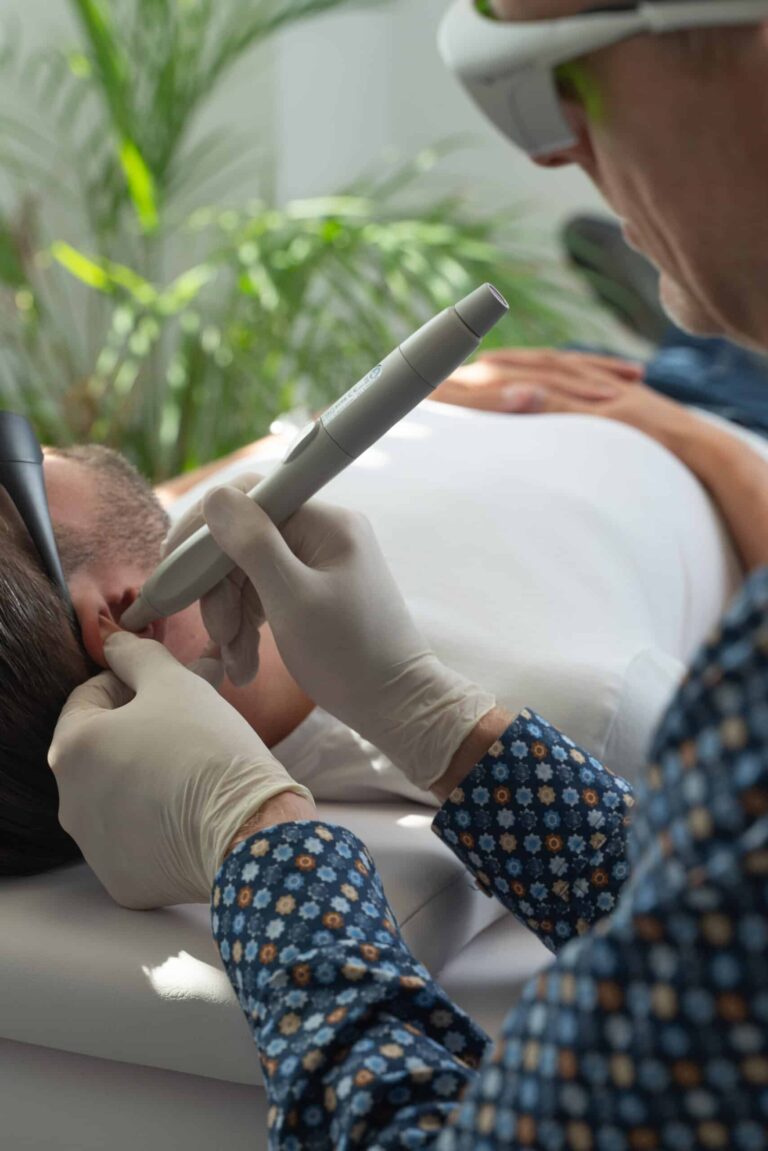
Given the limits of substitutes, laser auricular reflexology offers another route. This gentle method, with no needles and no nicotine, uses a soft laser to stimulate reflex points on the ear, along with a few points around the nose. This soft laser stimulation aims to reduce cravings and the feeling of withdrawal, with no smoke to inhale.
Unlike a patch, which supports withdrawal over a long period, this method targets cravings directly from the session onwards and may suit people who are tired of patches, gum or herbal blends.
The benefits of our laser method
Breaking free from tobacco is easier when cravings ease from the start. Laser auricular reflexology is based on a session of about one hour, using a soft laser, with no medication and no nicotine. Above all, everyone we support receives personalised follow-up: your practitioner remains available if you have doubts, feel stressed or have a passing urge to start again. A session of about one hour, 12 months of support: a free support session if you relapse within the year. In France, the session costs €190. Book an appointment at one of our Reset Laser centres to discuss your profile.
In summary
A tobacco substitute can be useful, but it all depends on which one. Nicotine replacement products (patches, gum, lozenges) increase the chances of quitting by 50 to 70%, at the cost of ongoing dependence and strict use [1]. Herbs, CBD and hemp mainly shift the gesture, without acting on nicotine. If you want to cut the craving rather than shift it, the laser stimulation method is a gentle alternative. To choose, also compare the methods for giving up tobacco and the mechanism behind cigarette addiction.
FAQ: tobacco substitutes
What is the best tobacco substitute?
There is no one-size-fits-all solution. Nicotine replacement products (patches, gum, lozenges) are the most effective for physical dependence, with 50 to 70% higher chances of quitting [1]. Herbs mainly accompany the gesture. The right choice depends on your profile and your motivation.
What are the alternatives to tobacco?
The main alternatives are nicotine replacement products, herbs or CBD to inhale, behavioural support and laser auricular reflexology. Each works differently: some supply nicotine, others target the craving itself.
What is the best substitute for quitting smoking?
The data show that correctly dosed nicotine replacement products work best [1]. Hemp products mainly help you cope with missing the gesture. Adding a method that acts on cravings, such as the laser, can complement the process.
What can replace the gesture of smoking a cigarette?
Many people turn to chewing gum, an inhaler, herbal leaves to roll or an object to keep their hands busy. These solutions do not act on nicotine, but they help you get through cravings in the first few days.
This article is for information only and does not replace the advice of a healthcare professional. Laser auricular reflexology is a non-medical support method.
Sources
- Assurance Maladie (ameli.fr, French national health insurance), “Tips for stopping smoking and tobacco withdrawal”. ameli.fr (2025)
- Tabac Info Service (Santé publique France), “Nicotine replacement products”. tabac-info-service.fr (2025)