Laser and cannabis: breaking free from an underestimated dependence
Quitting cannabis often turns out to be harder than expected. When they stop, many people discover withdrawal they were not prepared for: irritability, broken nights, no appetite, cravings that come back without warning. Reset Laser supports you through this period with laser auricular reflexology, a non-invasive method that works on the physical side of dependence. This page explains what the method does, what it does not do, and how a session unfolds.
- Cannabis withdrawal syndrome affects 35% to 75% of chronic users when they stop [1].
- Symptoms appear within 24 to 72 hours, peak between the 3rd and 7th day, then subside over two weeks [1].
- More than 75% of users in France mix cannabis with tobacco: nicotine withdrawal is often mistaken for a craving for cannabis [2].
- A laser auricular reflexology session lasts about 1 hour, is non-invasive and comes with 12 months of support.
Why quitting cannabis calls for support
THC acts on type 1 cannabinoid receptors, which are abundant in the prefrontal cortex, the hippocampus and the basal ganglia.
Repeated use makes the brain adapt: in daily users, imaging shows a 20% to 30% drop in the availability of these receptors [3]. This explains tolerance, the point at which you need to use more to get the effect you had at the start.
Receptors return
Receptors start to reappear within the first 48 hours, but normal density is only restored after about four weeks [3].
Cognitive recovery
Working memory, attention and processing speed recover over eight to twelve weeks [4].
This time lag has a practical consequence: the period when you are most likely to relapse is also the one when you feel least equipped.
Cannabis withdrawal symptoms
The most common signs combine emotional and physical symptoms.
- Irritability, anger, nervousness, anxiety
- Low mood, restlessness
- Insomnia and vivid dreams
- Loss of appetite, weight loss
- Headaches, sweating, tremors
- Abdominal pain
Insomnia and intense cravings are the two symptoms that can last the longest, sometimes for several months [1]. They are also the two main reasons people relapse.
We look at these reactions in more detail in our article on the side effects of cannabis.
The trap of tobacco-cannabis double dependence
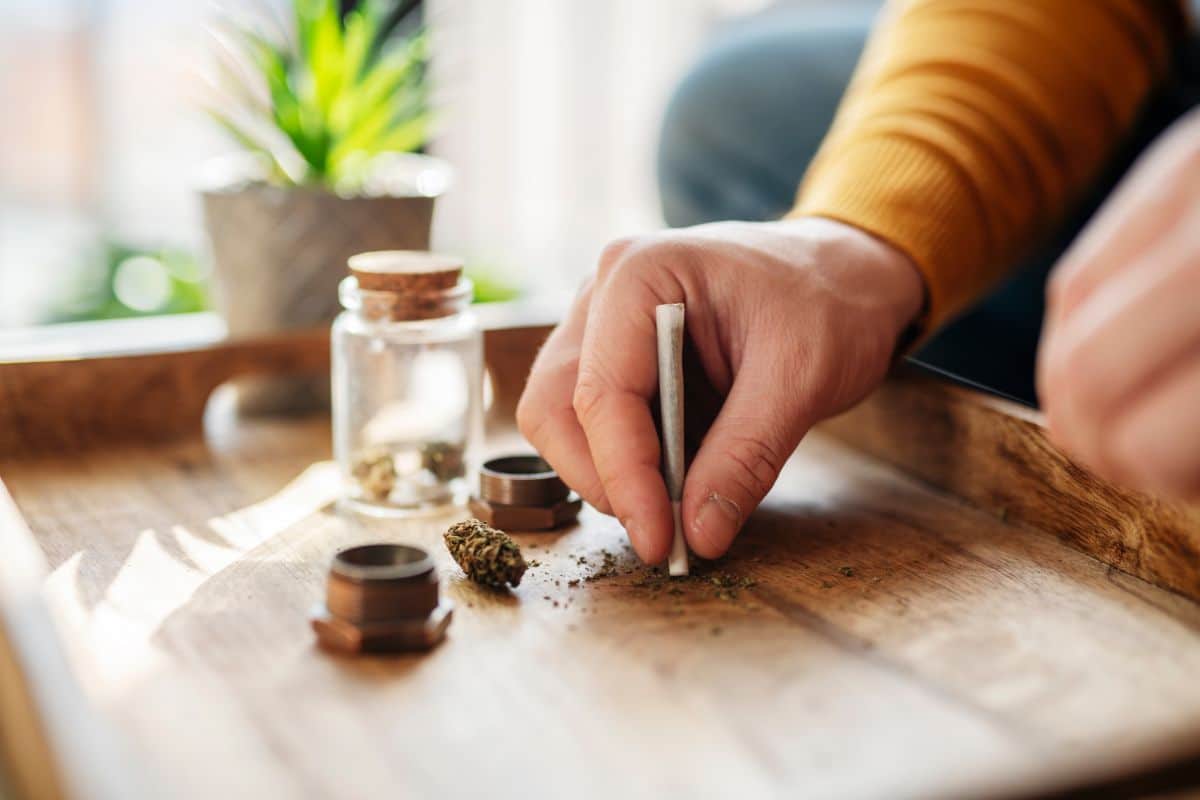
This is the most frequently overlooked point. In France and across Europe, more than three in four users smoke cannabis as a joint, combined with tobacco or as resin mixed with tobacco [2].
The two substances feed each other: tobacco helps vaporise THC, and THC eases the nervousness caused by nicotine.
When you stop, nicotine withdrawal kicks in at the same time as cannabis withdrawal. It is common to read it as a craving for a joint, and to start again for the wrong reason [2]. Supporting both quit attempts together makes a real difference, and that is exactly what an approach that addresses physical withdrawal as a whole makes possible.
How the laser works on cannabis dependence
The method is based on laser auricular reflexology: the stimulation of reflex points on the ear, and a few points on the nose, with a soft low-intensity laser.
No needles, no medication, nothing that breaks the skin. The procedure is non-invasive, and the session lasts about an hour.
The aim is to ease the physical side of withdrawal during the window when it is most intense, the first few days. It does not replace your decision to quit, and it does not act on the psychological and behavioural side: habits, situations and the people you use with call for work that takes time.
We say this plainly because it is the line we hold: the method is a source of support, not a promise of results. No medicine currently holds a marketing authorisation for cannabis withdrawal [5], and psychological approaches remain the reference for cannabis use disorders [5]. A session at a centre is a complement to medical or psychological follow-up, never a substitute for it.
To understand the full process, read how a session works or our method page.
What Reset Laser offers after the session
The session is only the starting point.
Personalised support for twelve months
A check-in after the session, then regular contact with the centre’s practitioner. This is the part we hold ourselves to the highest standard on, because the at-risk period lasts well beyond the first week.
A free support session if you relapse
Support continues for 12 months.
This commitment concerns the means we put in place and is not a promise of results, as success also depends on your own determination.
The network has 47 centres in 6 countries. You can book an appointment at your nearest centre or go back to the home page to discover the full support programme.
Pricing
Transparent pricing, no subscription, with twelve months of support. Choose your country to see the price in your currency.
Prices shown for France · in euros (€)
Solo
- One session of auricular reflexology with a laser
- About one hour
- Personal support for twelve months
- Support session offered in case of relapse
Group
2 people minimum
- One session of auricular reflexology with a laser
- About one hour per person
- Personal support for twelve months
- Support session offered in case of relapse
Companies
- One session of auricular reflexology with a laser
- About one hour per person
- Personal support for twelve months
- Support session offered in case of relapse
Reimbursement
Up to 100 % depending on your complementary health cover, on an itemised invoice, with no public health service paperwork.
How reimbursement worksPayment is made at the centre on the day of the session; no deposit is required when booking.
Frequently asked questions
Can laser help you stop using cannabis?
Laser auricular reflexology aims to ease physical withdrawal during the acute phase. It does not make psychological dependence disappear, and no method can promise that you will stop. Our commitment concerns the means we put in place: the session, the 12 months of support and the support session if you relapse.
How many sessions does it take to quit cannabis?
The protocol is built around one session of about an hour. A support session is offered free of charge within twelve months if you relapse. The practitioner reviews your situation with you during the initial consultation.
Does the session hurt?
No. The soft low-intensity laser does not break the skin and does not cause any pain. Most people describe nothing more than a feeling of gentle warmth.
What is the best approach to quitting cannabis?
There is no single answer. Motivational interviewing and cognitive behavioural approaches have the strongest evidence base [5]. A session at a centre can be added for the physical side of withdrawal. If you have been using for a long time or alongside other substances, talk to your GP or a specialist addiction service.
Should I quit tobacco at the same time?
It is often more comfortable, precisely because nicotine withdrawal gets mixed up with cannabis cravings [2]. This is discussed during the initial consultation, based on how much you actually use. Our article on the 7 steps of cannabis withdrawal covers this point.
Contraindications
As a precaution, the method cannot be offered to people in any of the following situations.
Situations that rule out a session
- Pregnant women, at any stage of pregnancy
- People with a pacemaker or an active implanted electronic device
- People undergoing intensive medical care (active chemotherapy or radiotherapy)
- People who are photosensitive or taking photosensitising medication
- Minors without parental consent
Sources
- Fédération Addiction, Addiction au cannabis, confinement et détention, 2022. federationaddiction.fr
- Stop-Cannabis.ch, Tabac, nicotine et cannabis : double dépendance, accessed 6 August 2026. stop-cannabis.ch
- Addiction Suisse, Cannabis : effets et risques, accessed 6 August 2026. addictionsuisse.ch
- Dervaux A., Krebs M.-O., Laqueille X., Les troubles cognitifs et psychiatriques liés à la consommation de cannabis, Bulletin de l’Académie nationale de médecine, 2014. academie-medecine.fr
- Deschenau A., Malécot M., Underner M., Prise en charge de l’usage combiné du tabac et du cannabis, Société Française d’Alcoologie, 2024. sfalcoologie.fr
Let’s talk about your situation
A session of about an hour, twelve months of support, and an initial consultation to review how much you actually use.