Laser to stop drinking: help to break free from physical dependence
Cutting down or stopping alcohol is not simply a matter of willpower. Regular drinking alters the brain’s chemical balance over the long term, and it is this imbalance that makes stopping so uncomfortable. Reset Laser offers support through laser auricular reflexology, focused on the physical side of withdrawal. This page explains what the method aims to do, the framework it fits into, and one precaution we want to set out from the very start.
A precaution to read before anything else
Stopping suddenly: a real medical risk
Alcohol is the only dependence we support for which stopping suddenly can pose a real medical risk. In someone with established physical dependence, abrupt withdrawal can trigger seizures and, in severe cases, delirium tremens, which usually appears between 48 and 96 hours after the last drink and is a life-threatening emergency [1].
If you drink every day, if you have ever had shaking or sweating on waking, or if you have already been through a difficult attempt to stop, talk to your GP before you stop. In most cases, a supervised withdrawal can be organised on an outpatient basis, with scheduled follow-up [2]. A session at one of our centres never replaces this medical supervision: it can be added to it.
We would rather lose an appointment than let someone put themselves in danger.
Where your drinking stands
The lower-risk drinking guidelines published in France by Santé publique France (the French public health agency) come down to three points [3].
- No more than 10 standard drinks a week
- No more than 2 drinks a day
- Some alcohol-free days every week
About 10 g of pure alcohol
A 25 cl glass of beer, a 10 cl glass of wine or a 2.5 cl measure of spirits [3].
The total is often a surprise
When they actually add it up, many people discover that they drink far more than they thought.
If you want to get a sense of where you stand, our article on the signs of alcoholism covers the warning signs, including for those close to you.
Why physical dependence makes stopping hard
Prolonged exposure to alcohol forces the nervous system to adapt. The brain constantly compensates for the depressant effect of ethanol.
When the alcohol stops, this compensation stays active for a few days with nothing left to offset: the system tips into hyperexcitability [1]. Nervousness, shaking, sweating, broken sleep, a general sense of anxiety: these signs are not psychological, they are chemical.
On top of this physical side comes a behavioural one: the evening aperitif, the end of the working day, meals, moments of stress. The two do not settle at the same pace, which explains why strong motivation can carry you for a while, then give way.
What the laser session brings
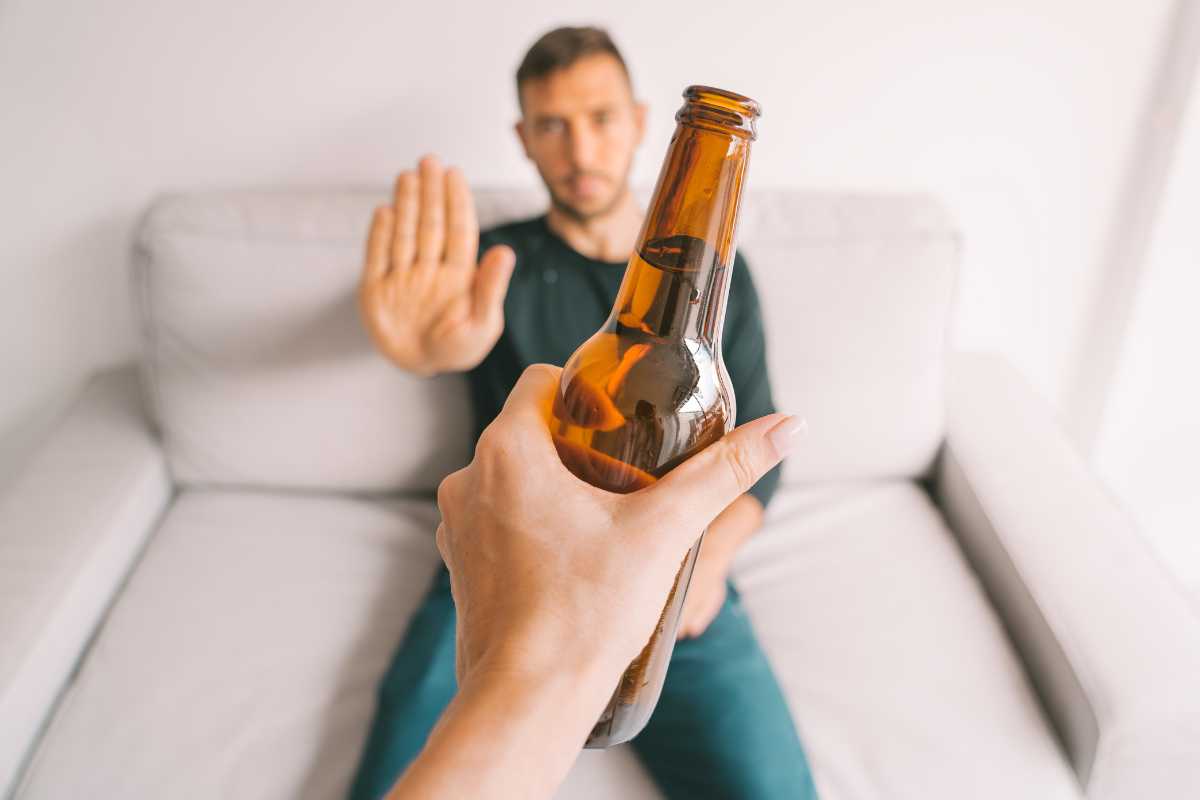
The method is based on laser auricular reflexology: stimulating reflex points on the ear with a soft, low-intensity laser.
No needles, no breaking of the skin, no medication. The session lasts about an hour and is non-invasive.
The aim is to ease the physical side of the urge to drink during the period when it weighs heaviest. The method does not act on psychological dependence, nor on the reasons why the drinking took hold. We do not promise that you will stop: our commitment is to the means, the framework and the length of the support.
The full process is described on our method page.
The follow-up is where it really counts
With alcohol, the real challenge is not day one: it is month three.
Personalised follow-up for twelve months
With the practitioner who saw you. This follow-up helps you spot high-risk periods, put substitute habits back in place and get back on your feet after a slip without seeing it as a failure.
A free support session if you relapse
The 12 months of support continue throughout.
This commitment relates to the means provided and is not a promise of results, as success also depends on your own personal determination.
To picture what lies ahead, our article details the benefits of stopping alcohol, day by day. And to talk it through in person, book an appointment at your nearest centre: the network has 45 centres in 6 countries.
Pricing
Transparent pricing, no subscription, with twelve months of support. Choose your country to see the price in your currency.
Prices shown for France · in euros (€)
Solo
- One session of auricular reflexology with a laser
- About one hour
- Personal support for twelve months
- Support session offered in case of relapse
Group
2 people minimum
- One session of auricular reflexology with a laser
- About one hour per person
- Personal support for twelve months
- Support session offered in case of relapse
Companies
- One session of auricular reflexology with a laser
- About one hour per person
- Personal support for twelve months
- Support session offered in case of relapse
Reimbursement
Up to 100 % depending on your complementary health cover, on an itemised invoice, with no public health service paperwork.
How reimbursement worksPayment is made at the centre on the day of the session; no deposit is required when booking.
Frequently asked questions
Does laser work for alcohol?
Laser auricular reflexology aims to reduce the intensity of the urge to drink linked to physical withdrawal. It does not make psychological dependence disappear, and it is no substitute for medical advice if you drink every day. Our commitment is to the means, not to a result.
Is it possible to stop drinking alcohol with laser?
The session is a support, not a stand-alone solution. The people who stay on track over time are those who combine the session, regular follow-up and a change of habits. That is why the 12 months of support are included.
Can I drink alcohol after a session?
Nothing physically stops you, but it goes against the whole approach. During the initial consultation, the practitioner reviews the high-risk situations with you, and the follow-up is there precisely to help you get through those moments.
How much does a laser session for alcohol cost?
The price is shown on our dedicated page and includes the session, 12 months of personalised follow-up and the support session if you relapse. In France, this service is not covered by the Assurance Maladie (national health insurance); some top-up health insurers (mutuelles) partly cover it under complementary medicine.
Contraindications
As a precaution, the method cannot be offered to anyone in any of the following situations.
Situations that rule out a session
- Pregnant women, at any stage of pregnancy
- People with a pacemaker or an active implanted electronic device
- People undergoing intensive medical care (active chemo or radiation)
- People who are photosensitive or taking photosensitising medication
- Minors without parental consent
Sources
- Société Française d’Alcoologie, Alcohol misuse outside dependence: good-practice guidelines (in French), accessed 06/08/2026. sfalcoologie.fr
- SRAE Addictologie Pays de la Loire, Outpatient alcohol withdrawal: protocol (in French), updated June 2022. srae-addicto-pdl.fr
- Santé publique France, New alcohol consumption guidelines to limit health risks (in French), accessed 06/08/2026. santepubliquefrance.fr
Talk it through before you decide
The initial consultation is there precisely to review how much you really drink and to check that this approach suits your situation.