Alcohol and sleep: why that evening drink wakes you up in the middle of the night
Published on 9 September 2026·Updated on 20 October 2026·6 min read
You fall asleep faster after a drink, then find yourself wide awake at 4am, unable to drift off again. This is far from a one-off: it reflects a precise, well-documented mechanism. In this article, Reset Laser explains what alcohol does to the structure of your sleep, hour by hour, and what happens when you stop.
🔑 KEY TAKEAWAYS
- Alcohol shortens the time it takes to fall asleep, then disrupts the second half of the night [1][2].
- It suppresses REM sleep early in the night and fragments the end of the night [2][3].
- It worsens night-time breathing events, especially in people who snore or have sleep apnoea [5].
- After regular drinking, sleep takes weeks to months to get back to normal [6].
- Insomnia left unaddressed doubles the risk of relapse; drinking to get to sleep triples it [6].
A night in two halves
Alcohol acts as a sedative: it shortens the time it takes to fall asleep and makes sleep feel easier [1]. That is why many drinkers use it to help them nod off.
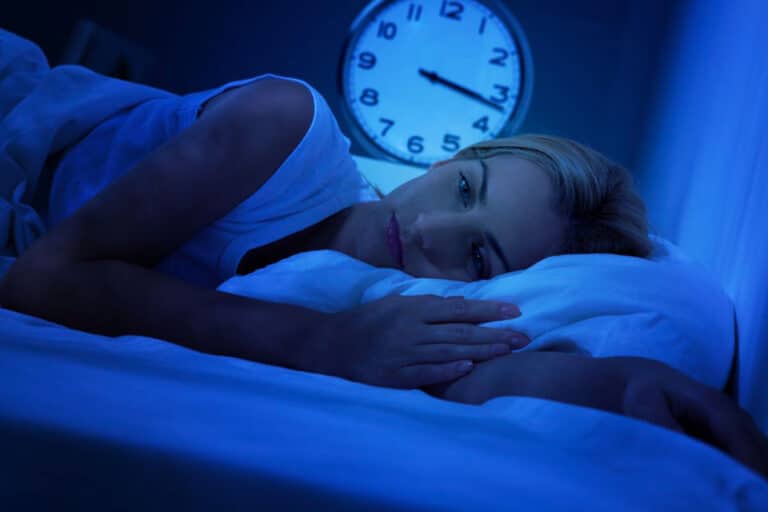
The problem appears in the second half of the night. As the liver clears the ethanol, the inhibiting effect lifts suddenly and the brain swings into rebound arousal [2]. Sleep recordings then show a surge in micro-awakenings, a clear increase in time spent awake after falling asleep and a drop in sleep efficiency [2].
This switch explains that 3 or 4am wake-up perfectly, along with the struggle to get back to sleep even though you feel exhausted. It is not tiredness that is lacking: it is the brake that has given way.
The sleep stages alcohol suppresses
A night is made up of cycles alternating between deep slow-wave sleep and REM sleep. Each has a different, complementary role: physical recovery for the first, memory consolidation and emotional regulation for the second.
Alcohol upsets this balance in two ways. In the first half of the night, it artificially increases the share of deep sleep and strongly suppresses REM sleep, which starts later than usual [3]. In the second half, the opposite happens and the night becomes fragmented [2].
On waking, the result looks like this: a sleep time that seems fine on paper, but a night that does not feel restorative, irritability in the morning and poorer concentration during the day. The quantity was there; the quality was not.
These effects are seen even at low doses, and they become more pronounced when drinking is repeated several evenings in a row [4].
Want to cut down or stop drinking?
Laser auricular reflexology supports your journey, alongside your doctor’s care. A single session of about one hour, with personalised follow-up for 12 months.
Snoring and breathing
Alcohol relaxes the muscles of the upper airways. This increases night-time breathing events, makes them last longer and deepens the drops in oxygen levels during the night [5].
The effect is moderate in someone without a breathing disorder, stronger in regular snorers, and much stronger in people who already have sleep apnoea [5]. For this last group, that evening drink is far from harmless.
How long until sleep gets back to normal
This is the question that comes up most often, and the answer calls for nuance.
After a few occasional boozy evenings, the night gets back on track within a few days. After regular, long-term drinking, it takes longer: sleep disturbances persist beyond the acute withdrawal phase, often for several weeks, sometimes for several months [6].
This period calls for patience, and it is better planned for than simply endured. The classic sleep hygiene measures fully apply: regular bedtimes, natural light in the morning, physical activity during the day but not late in the evening, no screens for one to two hours before bed, and no caffeine after mid-afternoon.
The vicious circle to be aware of
Here is what you really need to take away from this article.
Unaddressed sleep problems are among the strongest predictors of relapse in someone who has stopped drinking [6]. Pre-existing insomnia doubles the risk of relapse at five months, regardless of how severe the dependence is or whether depression is also present [6].
Worse still, using alcohol as a sleeping aid triples this risk, and relying on sedatives alone quadruples it [6]. In other words, the most intuitive solution, drinking to get to sleep, is also the surest way to stay dependent.
If you are caught in this loop, the way out is not a better sleeping pill but support that addresses both issues together. Talk to your GP, especially if you drink every day: in that case, stopping abruptly can be dangerous and must be medically supervised.
Breaking the cycle
The laser auricular reflexology offered in Reset Laser centres targets the physical side of the urge to drink, the part that makes the first few days so hard. It is a session of about one hour, using a soft low-intensity laser to stimulate reflex points on the ear, with no medication. It comes with 12 months of personalised support and a free support session if you relapse. This commercial commitment is a best-efforts commitment and cannot be taken as a promise of results, as success also depends on each client’s personal determination.
Find out more about support for quitting alcohol or book an appointment at a centre. Our article on the signs of alcoholism can help you assess your drinking.

OUR EXPERT’S ADVICE
Dr. Erick Hernández Jurado — General Medicine, Laser Auriculotherapy, Addiction Treatment
« The trap is expecting an immediate improvement. The first nights after stopping are often worse than before: REM sleep, suppressed by alcohol for a long time, comes back all at once, with intense dreams and waking in the night. Many people conclude from this that alcohol really was helping them sleep, and that is exactly when they start drinking again. Expect this phase. And when you are awake at 4am, do not lie there fighting it: get up, keep the lights low, do something boring, and go back to bed when you feel sleepy again. »
Frequently asked questions
What are the effects of alcohol on sleep?
You fall asleep faster, then the night is disrupted: REM sleep is suppressed early in the night, you wake up repeatedly in the second half, sleep efficiency drops and night-time breathing is disturbed [2][5].
Why can't I sleep after drinking alcohol?
Because the sedative effect reverses as the body clears the ethanol. The brain then swings into rebound arousal, which causes awakenings in the middle of the night and makes it hard to get back to sleep [2].
How long before bed can you have a drink?
The closer your last drink is to bedtime, the more disrupted the night. Drinking several hours earlier limits the rebound effect, but does not eliminate it. The only way to get back to a normal sleep structure is to stop.
Is a single drink enough to disrupt sleep?
The effects on sleep structure are seen even at low doses, and they build up when drinking is repeated several evenings in a row [4].
📚 Sources
- Société Française d'Alcoologie, Alcool et Sommeil (Alcohol and sleep), summary sheet, accessed on 06/08/2026. sfalcoologie.fr
- Colrain I.M., Nicholas C.L., Baker F.C., Alcohol and the sleeping brain, Handbook of Clinical Neurology, 2014. pmc.ncbi.nlm.nih.gov
- Chan J.K.M. et al., The acute effects of alcohol on sleep architecture in late adolescence, Alcoholism: Clinical and Experimental Research, 2013. pmc.ncbi.nlm.nih.gov
- McCullar K.S. et al., Altered sleep architecture following consecutive nights of presleep alcohol, Sleep, 2024. pubmed.ncbi.nlm.nih.gov
- Avraam J. et al., The influence of alcohol on genioglossus single motor units in men and women during wakefulness, 2023. pmc.ncbi.nlm.nih.gov
- Koob G.F., Colrain I.M., Alcohol use disorder and sleep disturbances: a feed-forward allostatic framework, Neuropsychopharmacology, 2020. pmc.ncbi.nlm.nih.gov
- Further reading: Inserm, Alcool et santé (Alcohol and health), in-depth report. inserm.fr
This article is for information only and does not replace the advice of a healthcare professional. Laser auricular reflexology is a non-medical support method.
Ready to take the leap?
Join the thousands of people supported by Reset Laser in taking back control over alcohol.