Signs of alcoholism: how to recognise a problem in yourself or someone close to you
Published on 4 November 2026·7 min read
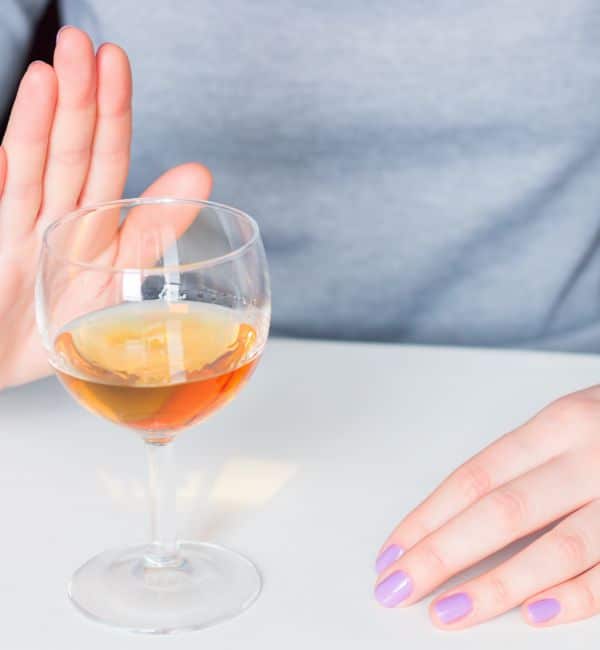
The word “alcoholic” boxes people in, and that is precisely what stops many of them from asking themselves the question. Professionals have in fact dropped this label in favour of a graded assessment, which places drinking on a scale rather than in a category. In this article, Reset Laser goes through the reference criteria, without judgement and without drama.
🔑 KEY TAKEAWAYS
- Today, professionals speak of alcohol use disorder, on a graded scale, rather than alcoholism [1].
- There are 11 reference criteria; 2 are enough to indicate a mild disorder, 6 or more a severe disorder [1].
- The AUDIT-C test, with just three questions, allows quick screening [2].
- The French guidelines: no more than 10 drinks a week and 2 a day, with some alcohol-free days [3].
- Shaking and sweating on waking point to physical dependence: do not stop on your own.
Why we no longer say “alcoholic”
International classifications have replaced the old distinction between abuse and dependence with a single, graded concept: alcohol use disorder [1].
This change is not just careful wording. It reflects a clinical reality: there are not two categories of people, those who have a problem and everyone else. There is a continuum on which each of us sits at any given time, and which can shift in either direction.
In practical terms, this means you can have a mild disorder without matching the image of an alcoholic at all, and that it is worth asking yourself the question long before you start to resemble it.
The 11 reference criteria
The reference assessment is based on 11 criteria observed over a 12-month period [1]. They fall into four areas.
Loss of control over drinking
Drinking more, or for longer, than intended.
Wanting to cut down or stop without managing to.
Spending a lot of time getting alcohol, drinking or recovering from it.
Feeling an overwhelming, irrepressible urge to drink, known as craving.
Social impact
Drinking gets in the way of meeting obligations at work, at school or at home.
It continues despite the relationship problems it causes.
Important activities are cut back or given up because of alcohol.
Risky use
Drinking in dangerous situations, such as behind the wheel.
Carrying on despite a known physical or psychological health problem made worse by alcohol.
Pharmacological criteria
Tolerance: larger amounts are needed to get the same effect.
Withdrawal: withdrawal symptoms appear on stopping, or drinking is used to avoid them.
Want to cut down or stop drinking?
Laser auricular reflexology supports your journey, alongside your doctor’s care. A single session of about one hour, with personalised follow-up for 12 months.
The three levels of severity
The number of criteria present determines the level [1]:
| Number of criteria over 12 months | Level |
|---|---|
| 2 to 3 | mild disorder |
| 4 to 5 | moderate disorder |
| 6 or more | severe disorder |
So two criteria are enough to speak of a disorder. This is probably the most useful piece of information in this article, because it puts the threshold much lower than most people imagine.
A word on method: this reading does not replace an assessment by a professional. It helps you work out whether the question is worth asking, not to stick a label on yourself.
The quickest test
The AUDIT questionnaire, developed under the auspices of the World Health Organization, is the most widely used screening tool [2]. Its short version, the AUDIT-C, comes down to three questions on how often you drink, how much you usually drink and how often you have heavy drinking sessions on a single occasion [2].
It is also useful to compare your drinking with the French low-risk guidelines: no more than 10 standard drinks a week, no more than 2 a day, with some alcohol-free days [3]. In France, a standard drink is about 10 grams of pure alcohol, which equals a 25 cl glass of beer, a 10 cl glass of wine or a 2.5 cl measure of spirits [3].
The most revealing exercise is still to write down what you actually drink for seven days, in standard drinks. Drinks poured at home are almost always more generous than a standard drink.
Signs visible to family and friends
Many people read this article on behalf of someone else. Here are the signs that most often raise concern, although none of them is conclusive on its own.
Explanations and excuses about drinking become more and more frequent.
Bottles are tidied away, moved or hidden.
Outings are chosen according to whether alcohol will be available.
The person becomes irritable when not drinking.
Lateness, absences or a drop in performance start to show at work.
Memory blanks cover entire evenings.
The first drink comes earlier and earlier in the day.
Comments from those around them trigger disproportionate reactions.
Physical signs of withdrawal
Some signs point to established physical dependence and change what you should do: shaking hands on waking, night sweats, morning nausea that eases after a drink, significant anxiety in the morning.
These signs matter for a specific reason: in someone who is physically dependent, stopping abruptly can cause serious complications, including seizures. In that case, stopping must be medically supervised, and you should above all not decide on your own to stop everything overnight.
What to do next
If several points in this article ring true for you, here are three practical steps.
Talk to your GP. They are the easiest person to approach, and they can assess the situation, refer you and organise supervised withdrawal if needed.
Contact a helpline. In France, Alcool Info Service offers free, anonymous support by phone or online.
Do not stay alone with this information. What sets successful journeys apart is not the strength of the initial decision, but having a support framework over time.
Discover our support for quitting alcohol to understand the approach.
Reset Laser support
The laser auricular reflexology offered in our centres targets the physical side of the urge to drink: a session of about one hour, stimulating reflex points on the ear with a soft low-intensity laser, with no needles and no medication. It comes with 12 months of personalised support from the practitioner who welcomes you, and a free support session if you relapse. This commercial commitment is an obligation of means and cannot be considered a promise of results, as success also depends on your personal willpower.
The initial interview is free of judgement, and it focuses on your habits, not on your worth.
Book an appointment at a centre or read our article on the benefits of quitting alcohol, day by day.
OUR EXPERT’S ADVICE
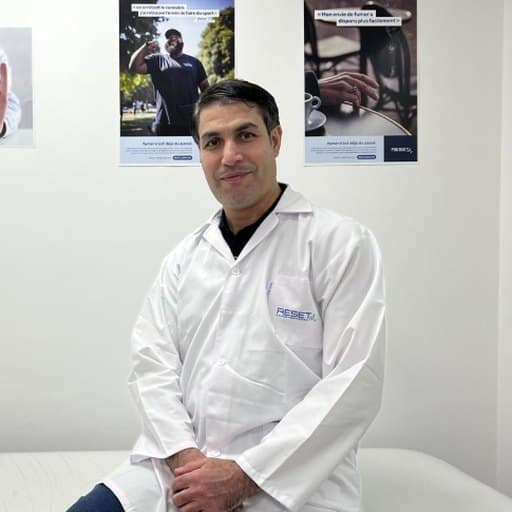
Dr Hamza Messaoudene — General Surgery, Medical Lasers, Addictology
« The criterion most often brushed aside is the second one: having wanted to cut down without managing it. Many people tell me they stopped for a month without difficulty, and present it as proof that there is no problem. A month off followed by a return to square one, repeated several times, ticks exactly that box. If you have already set yourself rules — one day off, nothing before 7pm, never alone — and you have moved them, count it. It is the rules that shift that tell you the most. »
Frequently asked questions
What are the signs that someone is an alcoholic?
Professionals assess 11 criteria: loss of control, irrepressible cravings, social impact, use in risky situations, tolerance and withdrawal symptoms [1]. Two criteria present over twelve months are enough to speak of a disorder.
What are the first signs of alcoholism?
Most often: drinking more than planned, failing to cut down despite meaning to, and growing tolerance. Physical signs of withdrawal appear later.
How do I know if I drink too much?
Compare your drinking with the French guidelines: no more than 10 standard drinks a week, 2 a day, with some alcohol-free days [3]. A seven-day log gives a more reliable answer than a general impression.
How can I help someone close to me?
Avoid confrontation and judgement, which mostly trigger denial. Describe what you observe rather than the conclusions you draw from it, and point them towards their GP or a helpline. Get support for yourself too: family and friends quickly become exhausted.
📚 Sources
- Haute Autorité de Santé (French National Authority for Health), Fiche 3 : détecter un trouble de l'usage d'alcool (TUA) : le DSM-5 (Sheet 3: detecting alcohol use disorder with the DSM-5), accessed on 06/08/2026. has-sante.fr
- AUDIT: Alcohol Use Disorders Identification Test (World Health Organization), Scoring the AUDIT, accessed on 06/08/2026. auditscreen.org
- Santé publique France, De nouveaux repères de consommation d'alcool pour limiter les risques sur sa santé (New alcohol consumption guidelines to limit health risks), accessed on 06/08/2026. santepubliquefrance.fr
- Further reading: SRAE Addictologie Pays de la Loire, Les 11 critères du DSM-5 (The 11 DSM-5 criteria). srae-addicto-pdl.fr
This article is for information only and does not replace the advice of a healthcare professional. Laser auricular reflexology is a non-medical support method.
Ready to take the leap?
Join the thousands of people supported by Reset Laser in taking back control over alcohol.