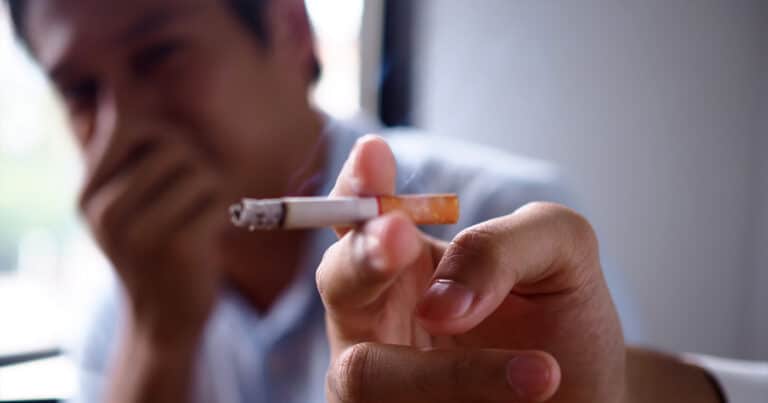
Social smoker: what does it mean and what are the risks?
You do not smoke every day. Only in the evening, at an event, with friends, sometimes with a glass of alcohol in your hand. You do not consider yourself a “real” smoker. And yet, you do smoke cigarettes!
This is what is known as a social smoker: a form of social smoking, often downplayed, but it is not without health risks. In this article, Reset Laser explains what it really means to be a social smoker, what the dangers are, and why it is best to act before addiction takes hold for good.
Social smoker: what does it really mean?
Social and occasional use
Social smokers are people who smoke occasionally, mainly in a social setting: parties, evenings out, outings, professional or family events.
Social smokers generally do not smoke alone. Their smoking is triggered by their environment. They do not smoke a pack a day and can go several days without smoking.
A practice normalized by society
In our society, tobacco still has a cultural and social dimension. The social pressure plays an important role here. Refusing a cigarette can sometimes feel like you are excluding yourself from the group. Smoking then becomes a tool for fitting in, almost a ritual. This context helps to normalize social smoking, by making it seem as though it has no consequences for health.
What are the risks of social smoking?
The trap of progressing addiction
Even low consumption exposes your body to nicotine, the substance responsible for addiction. With each cigarette, the brain registers a reward. Gradually, it associates certain social moments with the need to smoke.
Addiction does not depend only on the number of cigarettes smoked per day, but also on repeating the gesture and the emotional association. Gradually, consumption increases. Addiction sets in. What seemed occasional becomes a habit. Social smokers can therefore develop a psychological addiction, then a physical one, without ever having smoked daily at the start.
Cardiovascular diseases
Smoking causes an increase in blood pressure. Even low consumption increases cardiovascular risk: heart attack, stroke, circulation problems… Cholesterol oxidizes more easily and arterial walls become more vulnerable.
An increased risk of cancer
Smoke contains dozens of carcinogenic substances. Even if you only smoke at social events, you expose your cells to these toxins. In the long term, the risk of developing cancers increases, such as lung cancer. Accumulation, even when spaced out, eventually affects your health.
Respiratory diseases
Tobacco directly affects smokers’ airways. The toxic substances in smoke irritate the bronchi, weaken lung tissue, and trigger an inflammatory reaction. This repeated aggression, even when spaced out, gradually impairs respiratory function and can cause serious respiratory diseases.

How can you reduce the risks of social smoking?
Act before smoking becomes daily
Tobacco addiction develops gradually. Early intervention helps prevent this mechanism from becoming automatic and from having a lasting impact on your health. When use remains occasional, physical dependence is generally less entrenched. The brain has not yet established a daily need. Nicotinic receptors are less stimulated than with regular smoking. This is therefore the ideal time to make a clear decision and begin a smoking cessation.
After quitting: avoid high-risk situations
But even when physical dependence has been lifted, psychological dependence can still occur, especially among social smokers. Why? Because cigarettes were associated with specific contexts. The brain has registered these environments as triggers.
After quitting, it is therefore important to identify these problem situations that make you want. In the first weeks, avoid situations where social pressure is strong, as well as alcohol. The goal is not to isolate yourself from your social life, but to regain control of your body. Gradually, your brain dissociates these festive moments from cigarettes.

Reset Laser: a gentle method to quit smoking
Reset Laser offers a natural method based on laser auriculotherapy. By stimulating specific points located on the ear, this session of about one hour acts on the connections involved in nicotine dependence. The process is gentle, painless, drug-free and without nicotine replacement. A single session breaks this mechanism and allows you to regain complete freedom from tobacco.
You too, say stop to your addiction!
Why choose RESET Laser Institute
The best method to quit smoking
Specialist
Our practitioners are trained to support you effectively throughout your journey.
Effectiveness
Feedback from our clients reflects our success. Rated 4.9/5.
Painless
Non-invasive and painless, our method is accessible to everyone.

Stress-free
You free yourself from your addictions and quit smoking without weight gain, without stress, and without compensation.
Personalized support
Because each person is different, we offer personalized support.
1-year guarantee
Confident in the effectiveness of our technique, we guarantee our laser therapy for 1 year in case of relapse.