Alcohol and dopamine: what really happens in the brain
Published on 16 September 2026·Updated on 20 October 2026·8 min read

At first, alcohol relaxes you and lifts your mood. Years later, it barely does anything for you, and yet you keep drinking. There is nothing mysterious about this shift: it reflects a measurable change in the brain’s reward circuit, with dopamine at its heart. In this article, Reset Laser explains the mechanism and what recent research has to say about it.
🔑 KEY TAKEAWAYS
- Dopamine encodes wanting, not pleasure: you can intensely crave something that no longer gives you anything.
- Alcohol increases dopamine release in the reward circuit, with the help of nicotinic receptors [1][2].
- Chronic drinking creates a deficit: around 20% fewer D2/D3 receptors in the striatum, still present several months after stopping [3].
- Research linked to Inserm shows that a dopamine deficit can come before dependence and encourage it, not just result from it [4].
- Recovery takes months: what counts is how long you are supported, not how strong the initial decision is.
Dopamine is not the pleasure hormone
First, a common misconception to clear up. Dopamine does not encode pleasure but wanting: it tells the brain what is worth seeking out and triggers the motivation to go after it. The pleasure you actually feel depends mainly on other systems, notably the body’s own opioids.
This distinction explains something many people with a dependence describe without quite being able to put it into words: intensely wanting something that no longer brings any satisfaction. The wanting system stays active when the pleasure system has switched off.
The circuit involved starts in the ventral tegmental area and projects to the nucleus accumbens and the prefrontal cortex, the structures that manage motivation, reward-based learning and self-control [1].
What alcohol does from the first drink
Unlike most psychoactive substances, alcohol has no dedicated receptor. It works by altering several systems at once [2].
In the ventral tegmental area, it releases the brake that inhibitory neurons place on dopamine neurons. As a result, these fire more intensely and release more dopamine into the nucleus accumbens [2]. This is the signal that builds the association “alcohol equals reward”.
At the same time, other neurotransmitter systems, including the body’s own opioids, amplify the pleasant side of the moment [2]. The two mechanisms combine to etch the experience into memory, along with its context: the place, the time of day, the people around you. It is this associative memory, more than the substance itself, that will trigger cravings years later.
Want to cut down or stop drinking?
Laser auricular reflexology supports your journey, alongside your doctor’s care. A single session of about one hour, with personalised follow-up for 12 months.
The little-known link with nicotine
This point is rarely explained, yet it matters a great deal for anyone who uses both.
The nicotinic receptors in the ventral tegmental area play a direct part in the dopamine release triggered by alcohol. When these receptors are blocked experimentally, ethanol-induced dopamine release falls and the stimulating effects people feel are weaker [2].
In other words, tobacco and alcohol do not simply go together socially: they amplify each other in the brain. This is one of the reasons why stopping one often makes it harder to stay off the other, and why the subject deserves to be raised during an initial consultation.
When the system tips over: the deficit state
The tipping point comes with repetition. Stimulated artificially over and over again, the circuit adapts by becoming less responsive. The brain protects its balance, but at the expense of everything else.
Brain imaging shows that people with a dependence have around 20% lower availability of D2 and D3 dopamine receptors in the striatum, and that this reduction persists for several months after stopping [3].
This has three practical consequences.
Everyday pleasures fade. A meal, an evening out or a conversation no longer does much for you. This is anhedonia, often mistaken for depression.
Control weakens. The prefrontal cortex, which allows you to resist an impulse, works less well [3].
You drink to feel normal, no longer to feel good. Drinking changes its purpose: it is no longer seeking a reward but escaping an unpleasant state.
This shift explains why willpower alone so often fails. It is up against an established chemical imbalance, not a moral weakness.
What French research shows
A research team linked to Inserm (the French National Institute of Health and Medical Research) has added an important piece to the picture by studying another dopamine pathway, the nigrostriatal pathway, which is involved in motivation [4].
The researchers first observed a dopamine deficit in this region in animals that had become dependent. They then ran the reverse experiment: by artificially lowering dopamine levels in non-dependent animals to the level seen in dependent ones, these animals became dependent in turn [4].
This finding matters because it turns the question around. A dopamine deficit is not only a consequence of dependence: it can also be a cause. On this basis, the team tested a substance that stimulates dopamine production, and dependence was reduced as a result [4].
Two honest caveats: this work was carried out in animals, and a line of research is not an available solution. It does, however, shed clear light on what the people affected go through.
What this means for quitting
A word of caution first. In someone with an established physical dependence, stopping alcohol abruptly can cause serious complications, including seizures and, in severe cases, delirium tremens, which usually appears between 48 and 96 hours after the last drink. If you drink every day, or if you notice shaking or sweating when you wake up, talk to your GP before you stop. A supervised withdrawal is most often organised on an outpatient basis, with scheduled follow-up over the first few days.
Three practical lessons.
The flat patch in the first few weeks is normal and to be expected. The dopamine system takes time to readjust, several months according to imaging data [3]. Feeling flat, unmotivated or irritable after stopping does not mean you have made a mistake.
The circuit needs to be fed in other ways. Physical activity, regular sleep, projects that give you a sense of direction, social connection: anything that produces natural reward helps the system rebuild itself.
Support matters more than initial motivation. Since the period of vulnerability lasts for months, the challenge is not getting through the first day but being supported for as long as the brain needs to recover.
This is the thinking behind the support offered in Reset Laser centres. The laser auricular reflexology session, which lasts about an hour and is non-invasive, targets the physical side of the urge to drink by stimulating reflex points on the ear with a soft low-intensity laser, without medication. It comes with 12 months of personalised support from the practitioner who sees you, and a free support session if you relapse. This commercial commitment is an obligation of means and cannot be regarded as a promise of results, as success also depends on each client’s personal willpower.
Discover our support for giving up alcohol or book an appointment at a centre. Our article on the day-by-day benefits of giving up alcohol describes the timeline of this recovery.
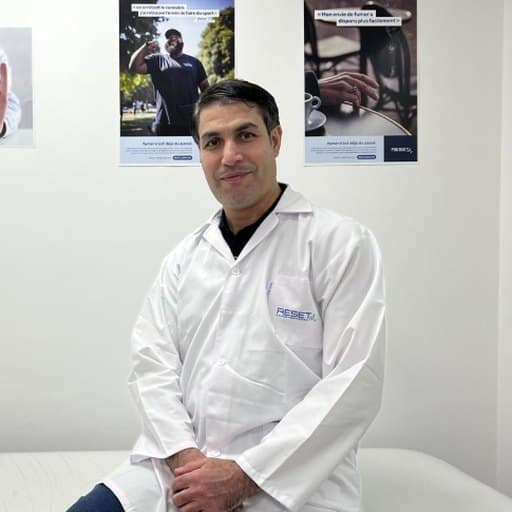
OUR EXPERT’S ADVICE
Dr Hamza Messaoudene — General Surgery, Medical Lasers, Addictology
« The question I almost always ask at the first meeting: do you smoke as well? Many people come about alcohol and set cigarettes aside without really thinking it through. Keeping tobacco is a perfectly defensible choice. Keeping it without having decided to, less so: smoking often goes up in the weeks after you stop drinking, and every cigarette brings the context of the drink back with it. Whether you stop both together or one after the other, make the call before you start and set a date for the second. »
Frequently asked questions
Does alcohol increase dopamine?
In the short term, yes: drinking alcohol increases dopamine release in the nucleus accumbens [1]. Over the long term, the effect reverses and the system becomes less responsive [3].
What effect does alcohol have on the brain?
In the short term, it alters several neurotransmitter systems at once and stimulates the reward circuit [2]. In the long term, it causes a lasting drop in dopamine receptor availability and weakens executive control [3].
How long does it take for dopamine to recover after stopping?
Imaging data show that the reduction in D2/D3 receptors persists for several months after stopping [3]. Recovery is gradual and goes hand in hand with improved motivation and a renewed ability to enjoy everyday pleasures.
What naturally increases dopamine?
Regular physical activity, enough sleep, exposure to daylight, social interaction and projects that bring regular achievements. These levers do not replace support, but they help you through the recovery period.
📚 Sources
- Gonzales R.A., Job M.O., Doyon W.M., The role of mesolimbic dopamine in the development and maintenance of ethanol reinforcement, Pharmacology & Therapeutics, 2004. pubmed.ncbi.nlm.nih.gov
- Morikawa H., Morrisett R.A., Ethanol action on dopaminergic neurons in the ventral tegmental area: interaction with intrinsic ion channels and neurotransmitter inputs, International Review of Neurobiology, 2010. pmc.ncbi.nlm.nih.gov
- Volkow N.D., Fowler J.S., Wang G.J., Baler R., Telang F., Imaging dopamine's role in drug abuse and addiction, Neuropharmacology, 2009. pmc.ncbi.nlm.nih.gov
- Inserm, Alcoolodépendance : la dopamine comme piste thérapeutique (Alcohol dependence: dopamine as a therapeutic lead), 2023. inserm.fr
- Further reading: Inserm, Alcool et santé (Alcohol and health), information file. inserm.fr
This article is for information only and does not replace the advice of a healthcare professional. Laser auricular reflexology is a non-medical support method.
Ready to take the leap?
Join the thousands of people supported by Reset Laser in taking back control over alcohol.