How to stop drinking alcohol: steps, support and a precaution not to ignore
Published on 2 September 2026·Updated on 20 October 2026·8 min read

Deciding to stop drinking is one thing. Knowing where to start is another, and the information out there often mixes common-sense tips with genuine medical issues. In this article, Reset Laser explains how to prepare to stop, why stopping abruptly is not harmless in some situations, and what makes the difference over time.
KEY TAKEAWAYS
- If you drink every day or get the shakes in the morning, see your GP before you stop: stopping abruptly can be dangerous [1].
- The official French guidelines: no more than 10 drinks a week, 2 a day, with some alcohol-free days [3].
- Preparation matters as much as the decision: a date, high-risk situations, ready-made answers, the people around you.
- Physical symptoms ease within one to two weeks; sleep takes longer.
- Long-term support is what sets apart the attempts that last [7].
The precaution to read first
Alcohol is not like other substances when you stop. In someone with an established physical dependence, stopping suddenly can trigger seizures and, in severe cases, delirium tremens, which usually appears 48 to 96 hours after the last drink and is a life-threatening emergency [1].
Three warning signs should lead you to see your GP before you stop:
- you have been drinking every day for several months
- you get shakes, sweats or nausea when you wake up, which ease when you drink
- you have already had a withdrawal that went badly, or a seizure
In these situations, stopping is organised with medical supervision. In France, it is most often done as an outpatient, at home, with scheduled follow-up over the first few days, sick leave and a ban on driving during the acute phase [2]. It is not a hospital stay, but it is not “overnight, on your own” either.
If none of these signs applies to you, you can consider stopping without any particular medical supervision. Advice from a professional is always useful, though.
Taking stock of your drinking
The guidelines published by Santé publique France, the French public health agency, come down to three points: no more than 10 standard drinks a week, no more than 2 drinks a day, and some alcohol-free days every week [3].
In France, a standard drink contains about 10 grams of pure alcohol. That is a 25 cl glass of beer, a 10 cl glass of wine or a 2.5 cl measure of spirits [3]. Drinks poured at home are almost always bigger than this: that is the first thing to adjust in your count.
The most useful exercise to start with: for seven days, write down what you actually drink, in standard drinks, without correcting anything. The figure you get is an objective starting point, rather than a rough impression.
Our article on the signs of alcoholism details the warning signs to look out for, including for family and friends.
Want to cut down or stop drinking?
Laser auricular reflexology supports your journey, alongside your doctor’s care. A single session of about one hour, with personalised follow-up for 12 months.
Getting ready: the steps that matter
Research on behaviour change describes a progression through several stages: you are not considering anything, then you hesitate, then you prepare, then you act, then you consolidate [4]. Mixed feelings are part of the process itself, not a lack of motivation.
In practice, there are four things to prepare before the big day.
The date. Pick a time with no major work deadline or big night out planned in the following ten days.
High-risk situations. List the moments when you drink without thinking: the end of the day, pre-dinner drinks, meals, Friday nights out. It is these habits that will catch you out, not thirst.
Ready-made answers. Decide in advance what you will say when someone offers you a drink, and what you will have instead. Improvising on the spot rarely works.
The people around you. Telling one or two people you trust makes a real difference, especially for the first few nights out.
What happens in the first few days
The body has adapted to the regular presence of alcohol by constantly offsetting its depressant effect. When the intake stops, this compensation carries on for a few days with nothing left to offset: the nervous system becomes overexcited [1].
This shows up as nervousness, mild shakes, sweating, broken sleep and a general sense of anxiety. These symptoms are chemical, not psychological, and they usually ease over one to two weeks. Sleep, on the other hand, often takes longer to settle back into a pattern.
Staying well hydrated with non-alcoholic drinks and eating regular meals make this phase easier. In cases of physical dependence, medical supervision includes vitamin supplements and close follow-up [2].
The support available
Several options exist, and they work well together.
Psychological support. Motivational interviewing and cognitive behavioural approaches are among the best-documented ways to cut down on drinking and prevent relapse [5]. They work on mixed feelings, high-risk situations and alternative responses.
Prescription medicines. Some medicines are prescribed to help people stay alcohol-free or reduce the urge to drink, on prescription from a health professional and with follow-up. They are genuinely useful, but always combined with psychosocial support [6]. This is something to discuss with your GP, not in an article.
Self-help groups. Free and available everywhere, they offer regularity and a framework that many people find nowhere else.
Non-conventional approaches, including laser auricular reflexology, are aimed at people looking for support with the physical side of cravings. They do not replace any medical supervision.
Staying on track for the long term
The real challenge is not the first day, it is the third month. Official French guidelines stress one point: after stopping, support needs to continue over time [7]. A one-off relapse does not take you back to square one. It should be seen as information about a situation you had not anticipated, not as a failure.
That is exactly the thinking behind the support offered in Reset Laser centres. The non-invasive laser auricular reflexology session, which lasts about an hour, targets the physical side of the urge to drink by stimulating reflex points on the ear with a soft low-intensity laser. It comes with 12 months of personalised support from the practitioner who saw you, and a free support session if you relapse. This commercial commitment is an obligation of means and cannot be treated as a promise of results, as success also depends on your own willpower.
Find out more about support for giving up alcohol or book an appointment at a centre.
To picture what lies ahead, our article on the benefits of giving up alcohol day by day describes what changes week after week.
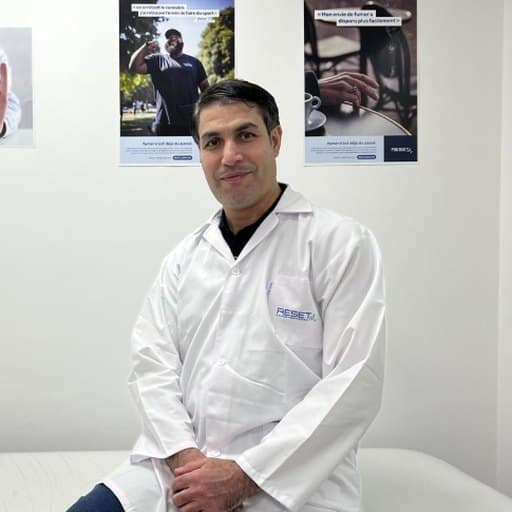
OUR EXPERT’S ADVICE
Dr Hamza Messaoudene — General Surgery, Medical Lasers, Addictology
« Sleep is the last thing to come back, and it is often how a relapse creeps in. For a few weeks you sleep badly even though everything else is already getting better, and the idea of an evening drink comes back, presented by your brain as a practical solution. Know this before you start, and do not judge your decision by your nights in the first month. If the insomnia persists beyond that, talk to your GP rather than trying to sort it out on your own. »
Frequently asked questions
What stops the urge to drink alcohol?
In the moment, getting out of the situation, drinking something else and letting ten minutes pass is usually enough: a craving is short-lived. Over the longer term, psychological support, prescription medicines in some cases [6] and approaches that work on the physical side of cravings are the documented options.
How can I stop drinking on my own?
It is possible if you drink occasionally and show no signs of physical dependence. If you drink every day, stopping without medical advice is not recommended because of the risk of complications [1].
How long does alcohol withdrawal last?
The physical phase usually lasts one to two weeks, peaking in the first 48 to 72 hours. Sleep and mood take several more weeks to recover.
What natural remedies help you stop drinking?
No herb or supplement has been shown to help people stop drinking, and some carry risks. What works is less spectacular: preparation, regular support, and changing your habits and settings.
Sources
- Société Française d'Alcoologie, Les mésusages d'alcool : référentiel de bonnes pratiques cliniques (Alcohol misuse: clinical good practice guidelines), accessed on 06/08/2026. sfalcoologie.fr
- SRAE Addictologie Pays de la Loire, Sevrage alcool ambulatoire : protocole (Outpatient alcohol withdrawal: protocol), updated June 2022. srae-addicto-pdl.fr
- Santé publique France, De nouveaux repères de consommation d'alcool pour limiter les risques sur sa santé (New alcohol guidelines to limit health risks), accessed on 06/08/2026. santepubliquefrance.fr
- Les stades du changement selon Prochaska et DiClemente (The stages of change according to Prochaska and DiClemente), accessed on 06/08/2026. cliniqueaddiction.com
- L'entrevue motivationnelle : un guide de formation (Motivational interviewing: a training guide), Eurotox, 2001. eurotox.org
- Assurance Maladie (ameli.fr), Les médicaments contre la dépendance à l'alcool (Medicines for alcohol dependence), accessed on 06/08/2026. ameli.fr
- Haute Autorité de Santé, Modalités de l'accompagnement du sujet alcoolodépendant après un sevrage (Support arrangements for alcohol-dependent people after withdrawal), accessed on 06/08/2026. has-sante.fr
This article is for information only and does not replace advice from a health professional. Laser auricular reflexology is a non-medical support method.
Ready to take the leap?
Join the thousands of people supported by Reset Laser in taking back control over alcohol.