When is Mois sans tabac? Dates, support and sign-up for France's quit-smoking month
Published on 7 October 2026·Updated on 20 October 2026·11 min read
On this page
- Quick answer
- What Mois sans tabac is and how it works
- Why Mois sans tabac takes place in November
- How to sign up and take part in Mois sans tabac
- Free tools and support to help you quit
- How to stop smoking for thirty days
- Health benefits of quitting smoking
- Nicotine withdrawal
- Who the campaign can help
- The role of professionals, associations and other players
- Quitting smoking with Reset Laser during Mois sans tabac
- In short
- Frequently asked questions
- Sources
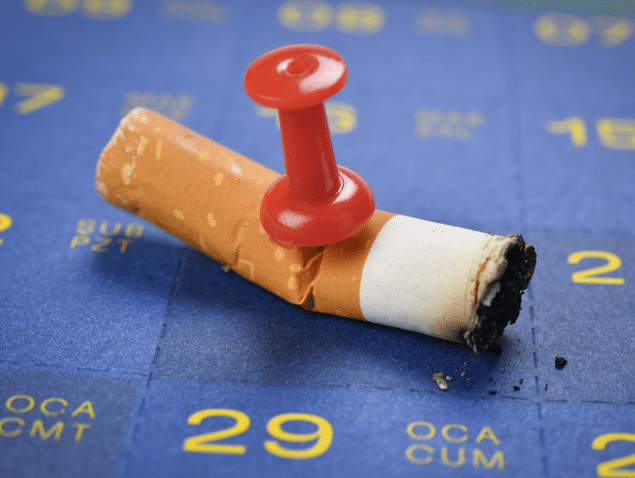
Mois sans tabac (“Tobacco-Free Month”), the French national campaign, takes place every year from 1 to 30 November [1]. Launched in France in 2016, this public health campaign invites smokers to take on a collective challenge: not to light a single cigarette for thirty days, with sign-up opening in October and free support along the way [2][3]. Exact dates, how the scheme works, the tools available, the health benefits and a method to see it through: here is everything you need to know before you get started.
🔑 KEY TAKEAWAYS
- Mois sans tabac, a French campaign, runs from 1 to 30 November, with sign-up opening in October [1][2].
- Thirty days without smoking make you 5 times more likely to give up tobacco for good [2].
- In France, a free kit, personalised coaching, the 39 89 helpline and regional events support participants throughout the challenge [2].
- Physical cravings peak in the first few days; after a week, taste, smell and breathing improve.
- Reset Laser supports people quitting smoking with laser auricular reflexology: a single session of about one hour, followed by 12 months of support.
Quick answer: when exactly is Mois sans tabac?
Mois sans tabac, France’s national quit-smoking month, runs from 1 to 30 November every year [1][3]. Sign-up starts in October so that every smoker can prepare to quit.
Key dates: sign-up in October, challenge from 1 to 30 November
The campaign gets going in October: signing up on the official website, collecting the kit and organising local events [1]. The challenge itself runs from 1 to 30 November inclusive. In France, the Ministry of Health and the Regional Health Agencies (ARS) promote the campaign in every region, with local initiatives and a roadshow in some local authorities [4].
An annual challenge since 2016
The campaign has existed in France since 2016, inspired by the British Stoptober, launched in 2012 [3]. Its principle stays the same every year: zero cigarettes for thirty days, a collective challenge backed by all the players in public health.
What is Mois sans tabac and how does this public campaign work?
Mois sans tabac is a French national information and prevention scheme run by the Ministry of Health and Santé publique France (the French public health agency) [2]. It aims to help smokers stop for thirty days through structured support and free tools.
Part of France’s National Tobacco Control Programme
The campaign is part of France’s National Tobacco Control Programme 2023-2027 [2]. It brings together health professionals, smoking cessation specialists, associations and local authorities around a shared goal: reducing smoking through a collective campaign that is accessible and visible in every region.
Why thirty days change your chances of quitting
Managing a full month without smoking makes you 5 times more likely to give up tobacco for good [2]. Beyond the physical cravings, which fade within a few weeks, it is the daily habit that breaks when a smoker holds out for thirty days without a cigarette.
Want to quit smoking?
Laser auricular reflexology supports your quit journey. A single session of about one hour, with personalised follow-up for 12 months.
Why Mois sans tabac takes place in November
November offers a neutral window, between the back-to-school period and the end-of-year festivities, well suited to a collective commitment with no excuse to put it off.
- A neutral period: no New Year’s Eve, no long school holidays, fewer festive occasions that encourage smoking
- Collective momentum: the whole of France starts on 1 November, and the group effect boosts motivation
- Preparation in October: a month of warm-up lets you identify your triggers, gradually cut down and sign up to the programme
- A tried-and-tested international model: France drew on the British Stoptober (2012), which showed how well a public month-long challenge can work [3]
This preparation phase matters as much as the challenge itself. If November doesn’t suit your calendar, set yourself a deadline and line up support from the start.
How to sign up and take part in Mois sans tabac
Sign-up opens in October on the official French website mois-sans-tabac.tabac-info-service.fr and in the Tabac info service app [2]. Signing up is free and open to everyone.
When does sign-up open?
Registration opens in early October and stays open throughout November [1]. You can join the challenge at any point during the month.
Where to sign up and get your support kit
The free kit can be downloaded online or picked up from local partners in France (pharmacies, associations). It contains a challenge planner, practical tips and a guide to accessing personalised support.
Taking part alone or in a group challenge
You can take on the challenge alone, as a team, at work or with friends. Events organised in the French regions, shared on Facebook and Instagram, create a support community that boosts motivation day after day.
Free tools and support to help you stop smoking during the month
In France, several resources are available free of charge to support participants [2].
| Tool | Support offered | Who it’s for |
|---|---|---|
| Mois sans tabac kit | Challenge planner, tips, guide | Everyone who signs up |
| Tabac info service app | Daily personalised coaching | Smokers who use their phone |
| 39 89 helpline | Direct conversation with smoking cessation specialists | People who need to talk things through |
| Smoking cessation specialists and professionals | Follow-up adapted to related addictions | People with strong dependence |
| Facebook groups, regional events | Group support and testimonials | All participants |
Coaching and personalised support are the two most helpful levers for staying the course. Smoking cessation specialists point you in the right direction depending on your level of dependence and any related addictions.
How to stop smoking for thirty days: a method that works
Success comes in three stages: prepare, start, hold on.
Before you start: preparing to quit
Write down your triggers (morning coffee, breaks with colleagues, stress), set your quit date, tell the people close to you and prepare concrete alternatives: water, a short walk, something to keep your hands busy. To structure your action plan, read our complete guide on how to quit cigarettes. Planning ahead like this eases the mental load of the first few days.
The first 3 to 7 days: managing cravings
The first few hours are the most demanding phase. Each craving rarely lasts more than 3 to 5 minutes. Drinking water, going out for a walk, using the app or, in France, calling 39 89: these tools help you get through each peak without giving in.
Holding on until the end of the tobacco-free month
After the first week, cravings become less frequent. Keeping up your follow-up, celebrating each milestone and anticipating risky situations (a night out, an argument, tiredness) remain the best habits to make it to day thirty.
Health benefits of quitting smoking: from 24 hours to 1 month
Stopping smoking brings rapid, measurable benefits for the body.
After 24 hours and 72 hours
At 24 hours, carbon monoxide is cleared from the blood. At 72 hours, breathing becomes easier and energy levels pick up. This is also when physical withdrawal peaks.
After 7 days: the first visible effects
Taste and smell gradually return. Breathing improves and sleep settles into a regular pattern. These first visible effects are a powerful source of motivation.
After 1 month: lasting changes
Smoker’s cough eases, skin regains its glow and fitness improves. The risk of smoking-related cardiovascular disease begins to fall. Day to day, the freedom of no longer needing cigarette breaks changes how you see yourself.
Nicotine withdrawal: which day is the hardest?
The 3rd day is often described as the hardest, because nicotine leaves the body between 48 and 72 hours after the last cigarette.
Physical withdrawal shows up in several ways:
- Intense cravings: episodes of 3 to 5 minutes, several times a day
- Irritability and nervousness: a common sign in the first 72 hours
- Sleep problems: difficulty falling asleep, waking up in the night
- Tiredness: linked to the drop in nicotine stimulation
- Difficulty concentrating: temporary, it eases after a few days
Plan for this window with a short activity, active support (someone close, the app, the 39 89 helpline in France) and advice from professionals. It helps to temporarily cut down on related habits (alcohol, coffee) while you get over the hump.
Who can the campaign help?
The campaign is aimed at all smokers, whatever their consumption or their history of attempts to quit.
Smokers looking for a group setting
If individual motivation isn’t enough, the collective challenge and regional events bring a spirit of mutual support. Taking part as a team adds positive pressure and reduces the feeling of isolation.
People who need personalised support
Personalised support from a smoking cessation specialist, the 39 89 helpline or a non-medical method such as laser auricular reflexology suits people with several addictions or those who have already been through several relapses. Testimonials from former smokers who were supported reassure those who are still hesitant.
The role of professionals, associations and public health players
In France, public bodies and associations form the campaign’s network across the whole country [2].
Who can guide you during Mois sans tabac?
Smoking cessation specialists, doctors, pharmacists and addiction prevention workers can guide you. Santé publique France and the Ministry of Health coordinate the national campaign, backed by a roadshow in several regions [4]. A local association may also offer workshops near you.
Why this network helps with quitting and withdrawal
This network of professionals provides a safety net for the most vulnerable profiles: multiple substance use, repeated attempts, a need for reliable information on ways to quit. Being quickly directed to the right person speeds up the start of the quitting process.
Quitting smoking with Reset Laser during Mois sans tabac
For smokers who want structured, non-medical support beyond the public scheme, Reset Laser offers laser auricular reflexology using a soft low-intensity laser. The support is built around a single session of about one hour, followed by 12 months of personalised support: a free support session is offered if you need it. It is a gentle, non-invasive, drug-free method that fits well with the momentum of Mois sans tabac. Book an appointment at your nearest centre to prepare to quit.
In short
Mois sans tabac sets 1 November as the national starting point in France to stop smoking for thirty days, with preparation in October and free support throughout the challenge. Holding out for a month makes you 5 times more likely to quit for good [2]: combining public tools, coaching and group support is the strongest lever to get there. For those who want to go beyond the public scheme, a stop-smoking laser session with Reset Laser offers a complementary non-medical setting, with 12 months of personalised support. As every year, the next edition starts on 1 November: now is the time to get ready.

OUR EXPERT’S ADVICE
Dr Hamza Messaoudene — General Surgery, Medical Lasers, Addictology
« The challenge sets a start date, but nothing for 1 December. That is where I see the most relapses: thirty days held without difficulty, then a cigarette the day after the finish line, because the goal stopped on 30 November. Before you even start, write down what you will do on 1 December. And if you slip along the way, pick up again the very next day without resetting your counter to zero in your head: the days you have already done count, and your body has not forgotten them. »
FAQ: frequently asked questions about Mois sans tabac
When is Mois sans tabac each year?
From 1 to 30 November, in France, since 2016 [1][3]. Sign-up opens in October.
Why was November chosen?
November is a neutral period between the back-to-school season and the end-of-year festivities. This setting leaves fewer excuses to put things off and allows a visible collective commitment on a national scale.
Do you have to sign up to take part?
Signing up is not compulsory, but it gives you access to the kit, personalised coaching and the support community [2]. It is free and open to everyone.
Which is the hardest day when you stop smoking?
The 3rd day is often the most intense, because nicotine leaves the body between 48 and 72 hours. Active support (the app, the 39 89 helpline in France, professionals) helps you get past this point.
What are the effects after 1 month without smoking?
Breathing, taste, smell and skin quality improve. Sleep becomes more regular and the risk of cardiovascular disease begins to fall. Self-confidence grows.
Where can I find free help?
In France, on the official website mois-sans-tabac.tabac-info-service.fr, through the Tabac info service app, by calling 39 89 or by seeing a smoking cessation specialist. Reset Laser centres also offer tailored non-medical support.
What should I do if I relapse during the 30 days?
One cigarette does not mean you have failed the challenge. Get straight back on track, identify the trigger and lean on coaching or a professional to adjust your strategy.
📚 Sources
- Mois sans tabac Nouvelle-Aquitaine, campagne d’information et accompagnement au sevrage tabagique (information campaign and support for quitting smoking). moisanstabac-na.com
- Ministère de la Santé (French Ministry of Health), Programme national de lutte contre le tabac 2023-2027 (National Tobacco Control Programme 2023-2027). sante.gouv.fr
- GAE Conseil, Mois sans tabac : principe, dates et historique (Mois sans tabac: principle, dates and history). gaeconseil.fr
- Agence régionale de santé Île-de-France (Île-de-France Regional Health Agency), Mois sans tabac 2025 : un mois pour arrêter de fumer (Mois sans tabac 2025: a month to stop smoking). iledefrance.ars.sante.fr
This article is for information only and does not replace the advice of a health professional. Laser auricular reflexology is a non-medical support method.
Ready to take the leap?
Join the thousands of people supported by Reset Laser on their journey to quit smoking.